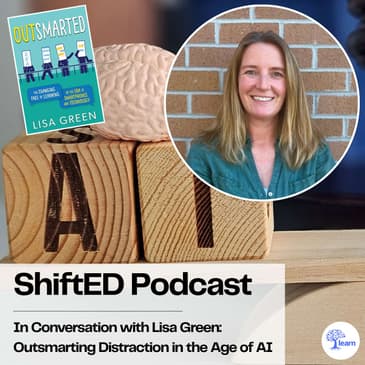
In this episode of ShiftED, we sit down with Lisa Green, Canadian author of Outsmarted: The Changing Face of Learning in the Era of Smartphones and Technology. Together, we explore how smartphones, AI, and the attention economy are reshaping classrooms and challenging traditional ideas about teaching and learning. Lisa shares practical insights on inquiry-based learning, student agency, digital literacy, and why keeping learning deeply human may be the most important task facing educators today. A thoughtful conversation for teachers navigating a rapidly changing world.
Welcome back everyone. Here we are, another uh episode of Shift Ed podcast. I'm reaching across our beautiful bad country, uh in over to BC uh to chat with Lisa Green, a teacher, author, consultant. Uh has this great book called Outsmarted. The changing face of learning in the era of smartphones and technology. And also an outstanding site called Here to Learn. I'll include all of these within the uh description of this podcast. So Lisa, thanks so much for carving a little 25 minutes here for us to chat about. I think a subject that we both hold dear to our hearts is education, learning, and making it stick in particular. And how we do all this with technology that's just uh surrounded by us and really integrated in our kids' lives seamlessly at this point. The front-facing phone started in 2009, I think. Well, that's where a lot of uh issues started happening. Um but maybe before we jump into that, I have a question of for you as to you do a lot of ink like project-based, and a lot of like, you know, the students are first, you know, more of them, less of us, teachers getting out of their way a little bit for their learning. When was it where you started to realize you had to shift that dynamic of me at the front of the class knowing everything, and I just have to disseminate it to more of a guide or a coach to our students as throughout their learning process?
Lisa GreenYeah, well, Chris, I'll just say thanks for having me. It's really it's good to be here and joining you. I I would say that that shift started to happen when the students started to, I wouldn't say no more than I did, but they started to question things that students had been questioning before. They had access to information in ways that I just didn't as a student. And um, that shift was a really difficult shift as a teacher. I'm sure that any teachers who were teaching during that time, especially those of us who grew up in an era where we that wasn't the case. The teachers we saw all stood in front of us and they lectured and they gave us the information and we listened and we trusted that information, and that was what it was. And then the information technology age just took over and students started being able to access everything they wanted when they wanted, and the pace of education shifted. And it was the students that guided that. I would say for me, kind of going, okay, you're, I wouldn't say you're bored, but you're getting like the content needs to be a little bit different, and how I deliver this content needs to be a little bit different for your learning. And so the project-based and the inquiry-based learning, it was a push within my school as well. My colleague that I worked with for a long time was Trevor Mackenzie, who was huge in pushing inquiry learning, if people should be aware of him and his work. And so watching the like inquiry-based and project-based learning kind of start to take root and and grow. And I was like, you know, I think I want to give this a try. I think like let's let's let go a little bit, which was really scary and difficult to do as a teacher for sure. And I think nowadays I found a bit of a balance with it because there's a little bit of that. But also I think the students are really requiring a lot of support as well these days. They're not actually strong. They used they were stronger then than they are now with it, I think.
Chris ColleyRight, right. And what were some of those strategies or techniques that you had to slowly adopt into your practice that that you found were the most beneficial and allowed you to kind of ease into kind of less of you and more of the students involved in the learning process?
Lisa GreenUh, it had to be really directed. Like I had to, for me, I had to be able to lay out a project and say, this is our goal. That was a big thing, is to like have the students know what the goal is. And we'll relate to the pro the podcast project because that was the largest thing I've ever undertaken. That project took over the course of a full semester with my students. Um, and I had to say, you know, okay, if we're gonna do this, then I need you all on board with this. And this is what we're gonna create. This this big podcast in the end that actually we're gonna make it available to the public and everywhere else. It's not just for school. And I need buy-in. And so I had them. What do you want to do? What topics do you want to do? And at that time, I will say, um, podcasts were still, I would say, in infancy stages, definitely with teens. They they were like, I had to teach them what a podcast was, which is crazy to even think about now. And they, they're like, I think they were game for it because it was something really new, and they they were like into wanting to learn about something new, but I guided them from this is the goal, here's what we're doing. Okay, we've chosen our topic. Now we need to decide what is it you're interested in pursuing from editing stage to recording stage to getting the students to buy in as a team. It was, it was a huge project. And I had my principal say to me when I first pitched it to her that I wanted to do something of this because it was, I was getting students out of the class to go to homeless shelters for interviews. They interviewed our city mayor. That was completely on them. I mean, there was so much to that project. And the and at the time she said to me, you know, this is kind of like a once-in-a-career type of project. And and it really was that that one year, that first year was the best. And then I tried to do it a second year and it wasn't as strong. And I haven't really been able to recreate that, honestly, because it was truly exhausting for me. Next year, I think with my new media class, I'm gonna venture back into it with much smaller scale, much on much smaller scale.
Chris ColleyRight. And what was that intrinsic thing that was in the students that was like, yeah, I'm into this? Like, how did you design it so that you knew you're gonna get engagement? Because I think too, like you said that there was no great, like it was after school closed when they had to submit it. So like the the what was in it that kind of grabbed them and was like, yeah, I'm into this. I love this. This is cool. Like, what were the aspects that you had to include to create that engagement?
Lisa GreenOh gosh, I wish I knew the secret sauce. I wish I could tell you. I honestly think it was the goal. The goal that we were doing this as a class. And and it was as soon as there was buy-in from like a group of them, there was buy-in from all of them. And I know one of the things, like it just it started taking on its own, it was its own thing. Like the students started asking for more time for it. And I think they knew because I was venturing into this for the first time, and I told them this is something new for me as well. We're gonna go through this together. That idea that we were in this together, not just them, but myself, I literally, again, was that guide on the side now for real. Um, their buy-in was bigger. And they were teaching me like editing skills that I had not learned before. So they got to like show off things that I didn't know. So I would say that that letting them be the leaders in this was, yeah, that ultimate guide on the side moment for me for them, and created the buy-in that it needed.
Chris ColleyThat's amazing. I love your book too, this you're outsmarted. What was the nucleus for that? Like, how do how did you get that idea? Okay, I want to put this book together and and make it, you know, it's not an alarmist. It's very practical and it's it's it's very down-to-earth, and it's like you can get into it easily as just reading it. Like, where did all that start from? Was it just a gathering of of strategies and ideas you had that you wanted to put put forth?
Lisa GreenYeah, it was it was a little bit of a combination of things. I I during COVID, um, I decided to take that time to do my master's work because like at the time and I've been wanting to do it. And so my master's work, which was looking at like organizational structures of things, had me questioning and looking at behaviors and um systematic, kind of social systematic things going on, which gave me the lens of looking at it through a school and a classroom lens. And then I was starting to see coming out of COVID, as many of us know, we started to see some pretty big shifts with our students. And while everyone around me was kind of saying, like, this was COVID that did this, I'm like, I don't think this was COVID. I think this was the screens and our like movement to go to so many screens during COVID that kind of shifted in a huge way how our students were learning, how they were socializing, how they were interacting. Like it was just almost like a kickstart into something we hadn't quite seen before. We'd see the inklings of it before, but then it was like this whole other animal when we got back and things started rolling. We tried as teachers to get back to normal, and students were like, well, I'm not the same, like, or I don't learn in the same ways. The phones had changed them. And so I started questioning that and looking at that and saying, like, I was hearing teachers around me struggling with this, I was struggling with it. And I was still hearing a lot of blame put on COVID and that we'll get through this. And I'm like, that's not what this is. And I think we need more help to get through this. And then I started looking at, well, what is causing this? What's going on? Okay, they're not focusing. Okay, the screens are causing this. What is it within the screens? How, and then, and then asking myself, like, well, what can I do in my classroom that's going to engage them? How can I engage them? Because, you know, that that just hitting my head against the wall, it's not working to keep doing the same things. So I started creating that. I started sharing that with teachers around. They're saying, this is really good stuff. I had some teachers say to me, like, you really should create. You should go farther with this. You need to create a book about this. So I kind of I like challenges. I was like, um, I'm no, I'm no stranger to writing. And I thought, well, let's go for it. I'm gonna try and create a book about this. And then uh the topics just started naturally coming from assessing in this world. And then, of course, at that time, while I was creating this, AI came into place. And I mean, that was like yet another shift. So that was, I was like, oh, what's this impact gonna be? If screens and phones have been in this back, what is AI now going to be doing to us in the classroom and their learning? So that I would say, hopefully that answers your question. That kind of led to this whole creation of this book.
Chris ColleyRight, right. Well, I mean, we're competing against engineers that have years and years of experience of designing something that they know the user is gonna want to use. I mean, these are smart people. They knew that putting phones in kids' hands was gonna create this. And I always kind of argue with people a little bit about technology as like, oh, technology is always seen as this so positive, proactive thing, but there's a really dark underbelly to technology itself, particularly when we don't talk about it. Which brings me to my next question is that we have all of these uh, you know, uh guidances, frameworks, you know, that that come down to us from above of like policies for how you to manage things in class and a proper use of technology and ethical and all of these frameworks that we get. Why do we so have such a hard time applying them in our classrooms? Because it seems like I say this often, is it's everyone's obligation to talk about these kinds of things, particularly now with the the AI being so dominant in every sector that we that we live in. Like, how how do we kind of like start to uh navigate that we need to talk more about it? It's not just about the tool and what the things can do, but it's about how do we use this stuff responsibly? How do we know when it's too much? How do we uh teach kids that their brains aren't formed well enough yet to understand separation from the technology and just embodying it? How do we get those conversations happening more, I guess, about the stuff about technology rather than about the tool itself?
Lisa GreenI think it's in the question you're asking right now. It's teachers are asking how, because we haven't been trained. I mean, it comes down from okay, we need to do this, like implement Chromebooks, okay. Actually, wait, too much screen time. And like there, there's a reaction, I feel, that happens at that, you know, administrative level where they are they're trying, and it comes from a good place of like, how can we better train the kids of today and the teens of today for the workforce tomorrow? And that's kind of their agenda. Um, and so they implement these things without really stepping back and thinking, well, what's the ramifications of doing this when it comes to actually how they learn? Not what they're learning, but how they're learning and how they are delivering the information that they're learning. And with teachers, we're most of us are coming from a place where we did not grow up with this. And now we're being asked to just implement it. And we haven't been trained how to ourselves, how to, there's no course in this right now. I haven't, I work with young teachers coming out of university. And when they hear what I'm doing, they're like, yeah, there's no, we're not being taught how to to react to this either. Like there's no training coming in for teachers into the reaction of what's kind of gone on with technology and phones. It's just we're on the spot, all of us reacting as best we can, which is kind of the teacher MO in so many things, so many ways. Um, but this this requires, I like I think this requires a pause and some big time training for teachers to react to what's happening. Because this shift has been at like at a scale we've never seen before. Like there's been information that's come in when it came in with the internet for the first time, and teachers adjusting to like, oh, okay, here's the internet. Here's the libraries are kind of dying off in the same way. And now we're going to be looking at how we research. But this with phones in every single hand with all of our teens and not just our teens, their families, their friends, all of society. Um, there's no courses. We don't, at least at my school and other schools around me, there hasn't been a course that's been in place, not just for teachers, but for students, like a very specific course that I think needs to come in and train students how to responsibly and ethically use their tech and also like what's socially acceptable. How do we make this like a social responsible thing as well?
Chris ColleyYeah, yeah. Because these are all skills that we need to acquire. And you don't just get taught skills, you have to practice them and you know, in embody them to an extent that you know, to to be able to navigate anyway. Um recently this year in Quebec, we we just implemented a bell-to-bell uh cell ban right across the whole province. And talking with colleagues and stuff, I mean it's it's kind of like, all right, we're banning, and then all right, here you go, good luck. Um what are some of your advices to schools that have implemented these bell-to-bells in how how can we still use technology that's available to us in carts or that we can go and get and still kind of like keep that at the forefront that technology or awareness of it has to be at the forefront? Because I think some teachers are kind of like there's this distraction now where they don't have their cell anymore, but they want things quicker. You know, it's like their brains have been so programmed now for immediacy, and when that's gone, it's causing kind of this free-for-all a little bit. What what are some of the advices that you that you've encountered that seem to be effective when schools go about saying, okay, we're gonna keep cells out of our schools?
Lisa GreenYeah, I think it's a start for sure. It's acknowledgement that we know it that it's making a big impact. But a lot of schools are implementing it, including my own, without backing up like the how. It's still on teachers in a lot of ways to say, like, hey, you know the rules here. They haven't, I think one of the biggest things to do as a school is to tell students why, why we are doing this. We just assume they understand why we're doing it. But it's, I mean, if you remember being a teenager and just being told to not do something, it's innate in teens to fight back against that. But when they understand the why of this, I see more buy-in from my students. So I tell them, look, this is what the phones are doing to you. This is what the attention economy is all about. And it is right now, like every every piece of an influencer who's out there right now is using you for your attention. And you cannot give it to me in the classroom. So I mean, it starts, I think it honestly starts with education of our students, what's happening with them. And then they start to understand it a little bit more. And so when it I tell them, okay, we know why we're doing this, they understand, they put it away. On a practical standpoint, um, I think that the phones have, you know, they've created behaviors, right? Our phones have created behaviors, they've trained our students, and we kind of have to create different behaviors with them from cueing. I mean, the behavioral thing about just like we sit in a waiting room or on a bus. As soon as we don't have something to do, just watch anybody around you. The cue is to grab our phones and go on it. So we've learned to do that. Our students have as well. So if we can cue them to different actions and reactions, we need to do that from having a honestly every class, my students walk in and they see my agenda. And it's a cue because it's like, this is what you're here to do. This is like our next steps. That cue could be from a thought question, maybe it's vocabulary they need to write down, maybe it's just the under what they're what they're doing that day. But the cue is you're here to learn, take out your papers. This is the next step. Uh sounds simple, but you're training a behavior. And then another cue I would say is really important for teachers is timers. I talk about this all the time, but when my students get focused on doing something, I'll say, this activity should take you 15 minutes. I'm putting a timer up on the board. That's the cue that this is work time. It's a cue for their brain that this is all they have left. So it's not just the idea that, like, oh, it's the timer's on, I should get to work. This is, again, I'm trying to train and cue for how much time they should be taking. So I think when we can, as teachers, develop these cues that we're trying to change behavior back to a learning space, then we're kind of fighting what the phones have created in the first place.
Chris ColleyYeah. Yeah. I love that too, like just those simple examples that you gave too, because it it not it creates a structure, but it also creates this awareness that this is going to be in your life all the time of you have to go and do a job and you're gonna have certain tasks you have to do, and there's gonna be time frames on it. So you're embedding all of these kind of life skills into these procedures that you're putting in place. Like there's a point behind them. Yes.
Lisa GreenRight.
Chris ColleyRight, right. But I mean, I find that's really interesting because we we also don't do enough of that kind of like getting them ready for the real world in the sense that just simple things of like, you know, proper etiquette on when I can use the phone, when I shouldn't use the phone, you know, like what I should post and maybe what I shouldn't post. Um, you know, when I reply to somebody online, maybe that language is not very nice, you know, and like you've got to go through those to start to understand and you know, embed them within yourself. Um, which brings me to AI. Now AI came out, you know, like 2022. It it it it changed a lot of stuff. I was at a conference recently with higher ed teachers, professors, and and they're really fixated on this plagiarism thing. Um and I think most teachers, that's kind of what they hung on to to exclude it or see it as something as a negative rather than the possibilities that might be embedded within it. When you talk with teachers and and and consult and in reflection on your book too, because it still applies to this as well. How do you change that narrative around the use of AI within a school context?
Lisa GreenYeah, this is a I would say the biggest thing we're dealing with right now. And you're right, the I see the reaction of being plagiarism and oh, this is written by AI. And you just, it's like, again, step back. This is where like kind of that that work organization piece looks in. Why are they using it? Well, the number one reason students use it is to save time. Well, they're they're trying to save time. Well, they're and I I've said this quite a bit, but like if we can teach them that the time that they're saving is the learning that they're losing, this piece is like for them, I think will create more buy-in to them not wanting to use it or using it responsibly because it's out there, like the phones. I mean, we can ban it in schools, but they're going to be on the phones outside of school. Same thing with AI. They're finding ways to use it. And again, tell a teen not to do something. And it's just innate in them to want to find ways to push the system because that is what a teenager is. That's what they do. So if they instead in my own classroom, for example, I have a new media English class, and I took this on because I wanted to, it gave me the opportunity to really go after these topics. So I have essay writing in the age of AI. That's the theme that I look at essay writing in. And I'm sure there's going to be teachers out there who disagree with me, and that's fine. But I have students first break down an AI-generated essay, which is the essay itself, the topic prompt is writing in the age of AI. Like, why is essay writing dead in the age of AI, or why shouldn't it be? So getting them to look at this. And then I get them to break it down. I want them to understand the essay from let's look for the topic sentence to the thematic statements to whatever else we're looking at in the essay. And then what's this essay missing and lacking? So they understand the structure. Structure of an essay, and then we go into, and then I talk about the skill sets. So if essay writing is dead, then they have a debate, a class debate about what skill set should survive. And I break down the skill sets of an essay, they argue again, they argue for each one, and they hopefully, you know, the miyagi moment is that they understand that they all matter. Um, but how do we then maintain and keep those skills? And so they hopefully create more buy-in. So again, I think if you just say don't use it, and then you're accusing students of using it, it's going to be an amazing battle. We have to find ways to teach them how to use it responsibly and why the skills it could be attacking. So I really, again, I think that's training for teachers, more training about how, like, what is it that AI is changing in your own classrooms? What do you see students using it for? And how can you engage and teach them to either use it responsibly? And if you don't want them to use it at all, I mean, I have a lot of students as well who are absolutely against it because of the water shortages and the worry about the data centers. And I think is very valid. Um, and so I'm not going to force them to use it, but there's a lot more who are curious about it right now. And it's definitely changing even some projects that I've done. I've seen students come up with some really incredible imagery and things that they've done through AI that I had no idea it could do yet. And that's again, they're teenagers, they're learning. They want to be engaged in things and curious. And so they're going to be curious with AI as well. And we have to kind of like join them in that curiosity. But again, that guide on the side, guide them responsibly.
Chris ColleyAbsolutely. Absolutely. I love that. It's we know it's not going to disappear. And it only seems to be getting more and more capable and powerful as you know the months roll on. Um, I love too how you were talking about like kind of AI proofing your your assessments, because you've got to start to rethink them, right? As because it's easy to say, okay, I need an essay on states of matter, go. Um, it'll spew stuff out until the cows come home. What are some other techniques that you've used, Lisa? Uh you had mentioned debating and like, you know, creating an argument and then doing it live. What are some more of those examples that you've seen or you've tried where AI is not, it's just one little tool to be a part of the process. It's not the whole, you know, it doesn't dominate the process.
Lisa GreenWell, I'll speak about two things. I say the first thing that I've implemented in my own classrooms is bookend assessments that assess students' knowledge at the start of the course and at the end of the course. And it's not for marks or anything, but they they'll have a question that they write to, it's them, a pencil, a paper, and that's it. That's all they get. And I keep that, you know, that write-up, that assessment, whatever it is, I mark it just on a little proficiency scale. And then at the end of the course, I'll do something exact, like similar, similar, but a little different. So I can like monitor that skill growth. If students have relied on AI, relied on tech to do a lot of the work for them, they do not see the growth that they would if they hadn't. And it's it's evidence. They they actually see it and they they kind of have learned now that I do this and they get to know it. And this came from a place of doing teaching languages, because language teachers know we've been dealing with translators for years before AI kind of came in. And if students relied on translators too much in my classroom, then they definitely didn't see that growth at the end of the year. And that was a massive learning moment for them. Like I don't see the same growth as students who haven't pushed themselves with this. So I'd say that that's one of the first things to for teachers to kind of implement is these bookend strategies where they are they are testing the skills that they know are going to be in their course to guide students to not use AI so they see their own growth at the end and understand it. And then I would say the other thing. I'm sorry, what's the let's go back to your original question? Because I feel like it did go off track a little bit.
Chris ColleyNo, like some practices for adjusting assessment for, you know, in the era of AI. I love that though, that portfolio kind of, you know, the process. Look at the process, look at the a a length of time, a duration of time. It's not just a one-shot deal. Here it is, and then I make my assessment on that. It it seems like that orientation that you're just pointing to right there is makes more sense.
Lisa GreenUh I I it's changed my practice. It has absolutely changed my practice. And I also have an interview with students at the end of the course. At the beginning, I bookend with interviews with my students at the beginning and end of the course. And so I can sit and talk with them about that growth and what they what they're proud of with that, what they feel they could have done a little bit better, and having that conversation is important. I think that goes to the next thing, which is oral assessments are really, really important. I mean, these have been big in Europe for years, and I think we need to bring back more oral assessments. I we need the time to do it because it is actually showing the knowledge in your head, whether that's with students who are just debating on two topics or um the students, you know, research a project and then they deliver it. And I don't want to say we're going to like give an oral presentation because that can be such a time kill in class. And I don't, I think, again, kind of lacks with students, they just read off notes. It's not like that. It's finding ways to do those, like going back to that classic, just like, what can you tell me? What have you learned? What can you tell me that you've learned, as opposed to like delivering that information in a written format? Because even if they have used AI to help them create their essay or something along the way, they need to study that. They still need to know the information. If they're unable to deliver it orally, they have not taken that information in.
Chris ColleyTotally. You can kind of tell, right, when you're a teacher that, yeah, these guys were only worked about five minutes on this, whereas opposed to I know, you know, this group, I it just see, you know, I can tell they spent more time they've internalized it.
unknownYeah.
Chris ColleyExactly. Exactly. Well, Lisa, I want to thank you. This has been really great. I love your book. I love the resources. I'll link to those. And I just wish you a great end of the year and a great summer as well. And thanks for sharing some insight with us today.
Lisa GreenYeah, I'm I'm I'm really happy to do it. And if I can just plug the press and play pro D. This Pro D that you you asked me a question earlier, just about like, why have I created a pro D that's deliverable in schools? And I mean, the answer is simple. Pro D is really expensive. And to get a speaker in these days is like the costs are high. I should know. I've I've made some money off of it, which is great. Um, but it's really hard for us who are teachers as well, like who are trying to be in the classroom and find the way out. Districts don't make it easy for us to leave. And so it's just it's a way to like, here's the information, here's what I want everybody to know. These are topics in my books. School-based pro D committees struggle to put pro D together because it's often off the side of their desk. And it's kind of, I just want to say here, take this information, take the time to deliver it with your staff, go through it, do what you can with it. Um, if you can have me in, that's great. If you can't, because you know, the whatever the things are stopping that, the price or even just my own timing, then at least this information is there for you to try and deliver to your staff. Because I really truly, from my heart, just want more teachers to have more information and engagement and more education about what it's like to and just the ability to talk about it. We just need to talk about what we're all going through right now so we can kind of start addressing it. So, yeah, thank you so much for having me on. And yes, this is awesome. Thanks, Chris.
Chris ColleyYeah, absolutely. And I I'll definitely include all of those resources in the descriptor in the blog post that I'll put up. Um and thanks for your time again. Just such a great pleasure to talk with you. Thank you.
Lisa GreenYeah, you too. Thanks so much. Have a good day and good rest of the year.