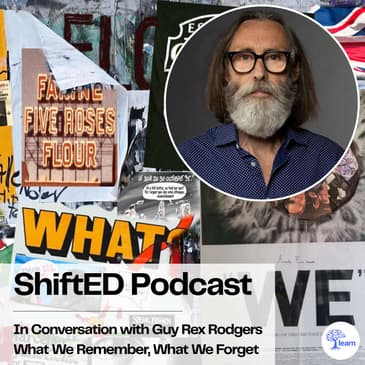
What does it mean to belong to a place that’s constantly redefining itself? In this episode, Chris Colley sits down with playwright, filmmaker, and author Guy Rodgers for a thoughtful conversation about identity, language, and the often-overlooked story of English-speaking Quebec. From his childhood between Australia and Canada to his deep dive into Quebec’s history, Rodgers shares the experiences that shaped his work—and why understanding our shared past can help us make sense of the present.
All right. Well, guy, what I'll do is I'll just reframe that question, and I'm not gonna do the intro again. I'll just use what what I had. Fine. You can you can splice that in shirt. Yeah, totally. Okay. So I'll just reframe that first question and then I can Okay. So you can't take back for the National Theatre School after a childhood split between Vancouver and Australia, and quickly found you didn't fully belong to either the Francophone or the historic Anglo world. How did that early question of where do I fit in here shape your work?
SPEAKER_01Well, the uh question of where do I belong actually preceded my arrival in Quebec when I was 12 years old for reasons that were totally random. My parents one summer sold their house, bought tickets on a boat to move to Australia. And even though Australia speaks the same language as Canada, more or less, get I am right. Um it was a culture shock, a surprising amount of culture shock in being the outsider, being the foreigner. And even though my younger brothers quickly became full Australians and they still live there, I never quite fit in. So when I finished university, I just headed off somewhere and I bought a one-way ticket to Berlin. Just it seemed exotic, seemed like a place to go. But on when I arrived in Canada visiting relatives, I saw an ad for a brand new playwriting course at the National Theatre School of Canada in Montreal. So I, as I was visiting relatives, I wrote a play, delivered it to Montreal, and then phoned them later in the summer from Dublin, and I was accepted. It was a total surprise. But oddly enough, I arrived in Montreal at the age of 26, and within a couple of weeks, it felt more like home than any place I'd ever been. At a sort of mega level. Now, at a micro level, the National Theater School was a bicultural institution. So half of the students were French, half of the students were English. This is 1980. So this is immediately after the first referendum. It's a particularly volatile, politically charged moment in history, to which I'm almost entirely oblivious. You know, we didn't get a lot of Canadian or Quebec Jews in Australia. So I found myself in an environment where you have all of these attractive young people kind of avoiding one another for political reasons. And the the Francophone kids, for the most part, could speak English, but chose not to inside Quebec for political reasons. And most of the English kids, yeah, they had a little bit of English they'd learnt at school, but not enough to really communicate. So I was just mesmerized by the passion, uh, the politics, the history. And so from the beginning, I realized I'm never going to be part of this francophone community, really, you know, because the enemy is people who speak English. And that kind of includes me. And yet I also realized that I didn't have the roots to really understand or to be part of the English-speaking community. So I I've been an observer for decades, observing, loving both crowds, um, but seeing how they they clash, they misunderstand one another. And so where do I fit in? Where do we all fit in? These have been major questions, and I've always talked to people about their own sense of belonging for all of those decades in Quebec.
Chris ColleyRight, great. That's so fascinating. And like you you started up a land, right? Like to um, you know, and the Quebec Writer Federation, the Drama Federation. What pulled you to the institutions and then helped you kind of start telling the story of what you were observing on the ground?
SPEAKER_01Well, again, the the story is is multi-strand. I mean, I studied playwriting at the National Theatre School, so I was interested in storytelling. You know, I'd been a songwriter before that. So storytelling was always something that fascinated me. And coming out of the National Theatre School, I worked on a number of major multimedia shows. Like I wrote the history of Canada projected onto the Parliament buildings in Ottawa. I wrote all of the content for the Canadian World Fair in 2000. In Montreal, when they opened the Pointe Carrier Museum in uh 1990, a friend of mine wrote the history and I translated it for the English version. But then when they redid it 10 years later, um, they had complaints that it was too franco-centric. So they wanted somebody with a with an outsider's perspective to rewrite the history. So I wrote that one that was in place from 2000 to 2010. So storytelling has always been part of my interest. But when I graduated from theater school, there were very few Anglo artists in Quebec. That was like the tail end of the exodus. There were very few institutions. And creating institutions as a as a as a base of support, of mutual aid, of a way of interfacing with the francophone majority became a sort of survival plan, a strategy for better integrating into Quebec. So that became such a big part of my life, especially after a land, that my creative side was kind of put on the back burner for a number of years.
Chris ColleyYeah, yeah. And you had this documentary then around COVID that you'd put together. I watched it and it's it's really powerful. I love that that stories are getting recorded, you know, that history of through, you know, an art form that we're recording and maintaining those. So what we choose to remember sets out to celebrate how Anglos and Aliphones adapted in the spirit of Bill 101 that was, you know, over 50 some odd years ago. I was so surprised to hear that the younger the people that have been here the longest feel less of a belonging as to the younger people that have been here per perhaps a little less time. How does that dynamic work, guy?
SPEAKER_01Like Yeah, yeah, that that surprised me too. I mean, for your listeners who've not seen the film, although if they want to see the film or read the book, they could simply go to whatwechs.ca where they're where they're freely available. But the film, what I mean, just to back it up one step, as I was sort of planning to go back to becoming a writer and a filmmaker, uh, and leaving the land, the Secretariat for Relations with English speaking Quebecers was doing some research into the sense of identity and belonging amongst English speakers in Quebec, and found to nobody's real surprise that very few English speakers have a strong sense of, I'm an Anglo-Quebecquer. You know, they have a sense of their family, their neighborhood, their work, many things, but they're not Anglo-Quebecers first and foremost. And many don't have a strong sense of belonging in Quebec. They have a stronger sense of belonging in their neighborhood and also to Canada than to Quebec. So, so there was this opportunity to the Secretariat wanted to fund some projects. And because you know, I've been a filmmaker, the way for me to approach that was to make some short films. And when you're talking about an English-speaking population in excess of a million people, and you're making, you know, even a feature-length documentary, you're you're interviewing maximum couple of dozen people, you know, maximum. So who do you choose to be representative of that story, that complexity? And that's where the idea of approaching it from the perspective of waves of integration. So a family that arrived immediately after the conquest has a different sense of belonging, a different sense of ownership than a family that arrived after the Second World War, or somebody who arrived as a student in the 21st century. And that proves to be quite an effective way of telling the story because even though we couldn't possibly touch on every single immigration group, every language, every country, every religion, people who arrived during the same period could say, yes, that that's that was what it was like when we arrived. That was the social political climate when we arrived, and and I identify with that. So that's a little sort of a long-winded preamble to answer your question. What it appears is that the earlier waves, the families that have been here for a long time, they've been hammered, they've been pushed around, they've been devalued, they've been mistreated, they've been made to feel unwelcome. Whereas the more recent, the post-1995 immigrants haven't experienced that. They've had a, you know, prior to Bill 96, we'll talk about that. My film was made just prior to Bill 96, but sort of post-95 and then prior 96, they had an overall positive experience. And so their sense of belonging to Quebec, precisely, was in general higher than families that had arrived after the Second World War or like way, way, way back, which was surprising. And yet, in a in a weird kind of way, it makes sense in terms of the turbulent historical period we've been through. And you know, that that explains also the massive exodus of hundreds of thousands of people. You know, why did they leave? Well, they didn't leave because they felt welcome.
Chris ColleyRight. Totally, totally. I mean, it's it's I found that quite revealing when that came up. Um, I loved at the end where the people that you were interviewing were putting up a one to ten on how much they felt like they belonged.
SPEAKER_01Yeah, they showed their hands, which is very very, very visceral uh way of expressing it, and and and the the expressions on their face and the body movement and the choice of the fingers, it's extremely powerful, and and all of them do it. And then uh the last person is a woman whose family arrived in the 1820s, you know, she's in her 80s, and she thinks about it for a minute, and then she boldly thrusts all 10 fingers in here. This is my home.
Chris ColleyWith a beautiful smile, and like the mom messing around. I love that.
SPEAKER_01The number of audiences that practically stood up and cheered when she did that. You know, yes, we also should be reclaiming our place here. This is our home too.
Chris ColleyAbsolutely, absolutely. And guy, what were some of the most revealing things that came out of those interviews? Because, like you said, you interviewed like a plethora of different, you know, people that were coming in or had been here for a long time, coming in with their own cultures. Like, what what did the documentary reveal to you as you know, a citizen here in Quebec?
SPEAKER_01Well, the documentary, I mean, the documentary is uh it's 93 minutes long, so it it it it it's a fairly superficial overview. I mean, it it tells it touches on a lot of things, but the book, for example, there's an English-speaking population in the Gaspay. And I knew that there were many towns, but what I didn't realize was how how deep the roots were. I mean, I wonder how many of your listeners know where the first English school in Quebec was established after the conquest. And I'm sure that most people don't know it. It was in Gaspey, Gaspe town. And uh that's because during all of the violence, that entire Gaspesian coast was was was depopulated. And when it was repopulated, it was from fishermen from the Jersey Islands and from Britain and American Royalists. And so Gaspay, in the year of the first census, was 75% English speaking. Now, how many people know that? And so there's this long and deep English history in the Gaspet that I kind of began to discover in the film and then really discovered when I could explore it in more depth when I was, you know, touring the film and writing the book. And similarly, you know, what when I think of Juan Naranda, you know, I think of that town that is French and is a mining town. But it was originally two towns. Naranda was the company town, and it was largely, you know, at least 50%. Actually, in the first census, it was 67% English or Anglo Aliphone, and only a third were were French speaking. And there are institutions there. We showed the film in a space called Le Petit Théâtre. There was a sort of a new marquee in in wood, but behind the marquee carved into the stone, it says Remembrance House, 1948. And so there are all of these traces of of deep English-speaking roots around the Quebec. And so the film opened up all of that to me and and certain small places that I just had no idea existed.
Chris ColleyWell, that's amazing. Yeah. And then did did the film then inspire the book to keep digging into these stories? Because I love this. So the film is is remember and the book is forget, right? What we choose to remember, what we choose to forget. How did how did the film inspire the book? And and what did it reveal that again was like, wow, like there's a lot going on here that a lot of us don't know about.
SPEAKER_01Well, I released the film in May 2022. Uh, it was the opening film at the Hudson Film Festival. June 2022 was when the CAC passed Bill 96. I mean, normally for a documentary film, there's a national and international film circuit that you hop onto and away you go. But my film was really about Quebec, and I really wanted to show it in Quebec. And because I had been executive director of land and I'd been involved with many community organizations, I had a lot of friends and connections around the province. So I asked them, would you be interested in showing this film in your communities? Because of the inherent interest in the subject matter of the film, but also in the added context of Bill 96 and needing to hear something positive about Anglos, everybody wanted to see it. You know, I showed it to 60 communities around Quebec, which is unheard of. And another thing that I discovered there that I had never really thought about is that my film approached the Anglo story, the Anglo-Alophone story for in terms of waves of immigration. But I realized as I was traveling around that the very old towns are on water. They're along the St. Lawrence Valley or its tributaries or the lakes. So when I would come into a town that has these deep, deep roots like St. Andrews on the Ottawa River in the Lower Laurentians, now called St. Andre, Saint Andre d'Argenteu, that's where Sir John Abbott was born. And it's the mouth of the La Riviera du Nord. You go up the river a little bit and you come to St. Columban, which was the first Irish settlement in 1810. So I got a sense of the layers of settlement. And then you come to railroads and bridges. The Victoria Bridge opens up the South Shore. So the first station is St. Lambert, a storied history. And then the suburban railway, the Southern Counties Railway, opens up the South Shore to the working class. And then you get places like Greenfield Park being populated. So the layers of settlement based upon the modes of transportation. And that's the way I structured the book. You know, each section is like you travel through this region first by water, then by rail, then by road, and discover all of the villages and the history. And it was just infinitely more detailed than I had imagined. And as I'm showing the book to people, even lifelong Quebecers, who am I? You're going, Wow, like I did a lot of this stuff I had no idea about.
Chris ColleyThat's amazing. That's amazing. And through the book, like it starts to open up this idea of Bill 96. Guy, could you kind of give us like what that meant to Anglophones and allophones within Quebec when that bill came in? Like it was it was a pretty big seismic shift that was starting to happen when that bill came in. Is that is that accurate to say? Oh yes.
SPEAKER_01Oh yes. I mean, Bill 96 was in many ways as much of a seismic shift as as Bill 101. The difference being that in the 1960s and the 1970s, there were documented serious social and economic injustices. You know, the francophone majority, unilingual francophones earned less than uh unilingual anglophones, which is you know just wrong. And so, and it was hard to find work in English, it was hard to be served in English. I mean, there were a lot of reasons for the Francophone majority to be upset. Now, one of the messages I was trying to get across in my film was that the Anglos and Aliphones who either chose to stay here or who arrived during that period bought into what we might call the spirit of Bill 101. Yes, there are injustices. Yes, we want to live in a more just society. Yes, it's important for us to speak French. So, you know, most people who who learned bad French or minimal French in high school made considerable efforts as adults for their professional and personal lives to learn French, to be able to, you know, socialize and and and and communicate professionally. And what I'm also discovering in a side project that I'm working on is that most of those people, those boomers and Generation X people who struggled with French went to great lengths to ensure that their kids had a better start. Immersion classes, you know, any summer camps, you know, francophone babysitters, whatever. But you know, it was a serious thing. So the film was about yes, we've contributed. This is a great place, and we should all be proud of ourselves. And our Francophone neighbors should recognize the role we've played. And then Bill 96 says, no, no, that was a failure. That was a disaster. You know, we're two eager signs away from being coming to Louisiana. And at first it was confusion, like, can this be for real? Like, is this really? And then it was kind of sadness. And I remember a screening in Ormstown when a woman in the audience said, you know, my family was one of the founders of this region. We we built, we, we, we founded the first apple orchard, and we're going to be celebrating our 200th anniversary in a few years. And we wonder if this cat government would like to help us celebrate, or if they would like to help us pack our bags and leave. And nobody in the room stood up and said, Hey, now that's crazy talk. Because people were feeling sad, they were feeling confused, they were feeling unloved. And as it went on, and and the whole attack on education and the cégeps and the universities and too much English in the streets, then people started becoming, you know, angry, annoyed and angry. And by the time I was in the 30 screenings, halfway into you know, a year and a half into Bill 96, it became clear that what I was witnessing was a multifaceted face of Anglophone, allophone, Quebec. During a time of translation transition/slash crisis, it was important for us to understand, and it will be important for people in the future to remember. And it's also important for our francophone colleagues to see this, to see what we were experiencing. Because one of the weird things about Quebec is that a politician can always say the French language in Quebec is fragile. We need to do something to protect it. And the francophone majority will always say, quite rightly, yes, yes, protect us. But Bill 96 was about attacking and diminishing and belittling to minorities, in many cases, to little or no benefit to French language or culture. And that's what I think the Francophone majority, for the most part, didn't understand. I mean, as the CACs became, and as they demonstrated that their bullying techniques and their lack of data, their lack of documentation, they're just following a feeling and then bullying it through. The rest of the population started to see how they worked and then could kind of understand that maybe they they applied the same the same treatment to English speakers and to and to immigrants.
Chris ColleyInteresting. It's so fascinating. We don't hear these stories enough. And it brings me to your book as well of what we choose to forget. What are what are we what are some of the things that we're forgetting as well? Like how do we have to keep these this history alive so that we don't forget?
SPEAKER_01Well, yes. I mean the the the the film choose to remember, you know, we can choose to remember many positive things we've done together. That was my hope to establish a you know a piece of film that could be screened by anglophones, francophones separately or together and encourage a a positive conversation. The book, What What We Choose to Forget, I mean, this is about erasure. This is about deliberate cancellation. It's about a deliberate process of ignoring or denying. The history and the contributions of a group of people. And if you just take Montreal, I mean, if you go back to 1760, the year that Montreal capitulated to the British Army, what is left from that Nouvelle France period in Montreal? Well, the short answer is not very much. You're talking about half a dozen buildings. I mean, even Not Badan Church was built nearly 100 years later by an Irish architect. So most of all Montreal was built during the British regime. Therefore, from an immigrant perspective, we, the non-Francophones, those with who do not have roots going back to the pre-conquest era, we feel that we have contributed, that we have co-created this modern society. And there was a great comment at a screening at Casa d'Italia for the Francophone community, where one of the people in the audience said, you know, when I pick up friends at the airport and I drive through downtown Montreal, I say, look at those skyscrapers. He said, Italians built those. He said, now Italians own them. And that sense of we contributed to build this. And you know, now we're you're taking our place, and this should be recognized. And that came up again and again. We don't want to say we're better. We don't want to say, we just want to say we're here. We contribute. Why can't we all sort of share that pride together? And so that's what the book is about. There's a sort of duality between the frustration of what's going on. And on the other hand, we like Quebec. That's why we're here. You know, there's so much good about it, and our personal relationships with our friends and our neighbors. Many of us are married to Francophones. You know, there's all of that that is extremely positive. And that's what is being forgotten, and that is very dangerous.
Chris ColleyTotally, totally. And we can coexist. I mean, we've been doing it for a long time, but I agree with you. Some of these bills and laws that come in really feel like suppressive in nature, and that you know, can we can we forget about, you know? And that's why I felt that your book was so interesting, is that you're putting your hand down and saying, no, we can't forget about these things. We have to look over to our histories.
SPEAKER_01And there are just some vindictive things. I mean, I there's an entire chapter in the book with youth, because you know, many of the people who came to the film are boomers, slightly older, slightly younger. But I visited two high schools, CEGEPS, and all three universities. And so I wanted their view to be expressed. Now, 15 or 20 years ago, when I would talk to a university group about language, you know, they'd go, they'd roll their eyes and go, oh, come on, that's such a boomer thing, you know. Right? We speak French, we speak many languages, we don't care about language. You know, we're concerned about the environment, we're concerned about justice, we're concerned about, you know, many things. And yet, when I was touring the film during that whole Bill 96 that attack on the schools, I saw the fear vindictiveness of the legislation. There was one very good example. Uh, a woman who teaches at Marianapolis said that for the SageFs, they were given quotas. And it's very complex to plan the exact number of students who are going to enroll. Lots of people imply, you choose them. Some that you choose have already gone somewhere else. So let's say your quota is 100. You know, you're going to be 110, 95, you know, you're going to be up or down a little bit. The legislation was built to be lose-lose. If you go over your quota, you're penalized. $15,000 per student. If you if you play safe and go under your quota, the government can say, well, you didn't use your quota, so we're going to reduce it. I mean, it's definitely just maliciously designed to be lose-lose. And it blindsided the schools and it to what end? And so the kids understood that. I mean, the kids that I talked to were saying, one, for example, a kid from Ontario who said, I've always just been crazy about Quebec. I thought it was the, you know, Montreal was the coolest city in Canada. But I came here, I did a stage, and I'm getting the sense that, you know, there's a lot of I would be unwelcome here. I don't know if I'd have a future here. So this is a kid who's kind of been dreaming his whole life, but coming to Quebec, being a teacher. I mean, do we need teachers? You know, the kid feels anybody doesn't have a future here as a teacher. I mean, that's shocking.
Chris ColleyYeah.
SPEAKER_01Well, that's crazy.
Chris ColleyThat's crazy. Well, guy, this has been very short, but tons of history that we've covered. I would definitely love to have you come back and and continue this conversation. Because it is keeping, we have to keep history alive and we have to learn from it as well. And I think that your stories and your connection with that history makes us all a lot smarter. So I put it on.
SPEAKER_01Well, thank you, Chris. I'd just like to say to your leaders, to your to your listeners, that all of this stuff is available on the new website, whatwechose.ca. You can get the film and get the YouTube link. There are two electronic versions of the book, a PDF and an EPUB. They're free of charge. I mean, obviously, I have to charge for the book because there are costs. And also, we haven't even talked very much about the whole education research project that I'm doing, but all of that documentation is on the same website. So if people are interested in what they've heard now, they can go and follow up a lot of material on the website. So whatwechose.ca is all there.
Chris ColleyAmazing. I'll definitely put that in the show descriptor as well, so you have a quick link to it. And also, Guy, I wanted to also, there are resources for schools too, right? That you have made available as well.
SPEAKER_01For the film, yeah. So on a film's website, which is this separate link. There are teachers' resources, yes. Because I I saw one class where there's where we showed the entire film, and like having kids sit still without their phones for 93 minutes was like torture. So we don't want to torture kids. We don't want to turn them off history. So we've broken the film down into little units that can be uh of approach from different angles, historical activities, make an eye, make a podcast, talk to your grandparents. So yeah, there are all kinds of tools there uh on the film's website that have been designed and apparently work very well in the classroom.
Chris ColleyAmazing. Well, I'll include those. Um teachers out there, listeners out there, please go and have a look at this information and what guy's been working on. And I would love to have you come back once uh your new projects are kind of hitting hitting the road and we can continue this.
SPEAKER_01Absolutely, we'd love to. So thank you for thank you for having me.
Chris ColleyThanks so much, guys. Okay, bye-bye.