Language is the foundation. Everything else is built on it.
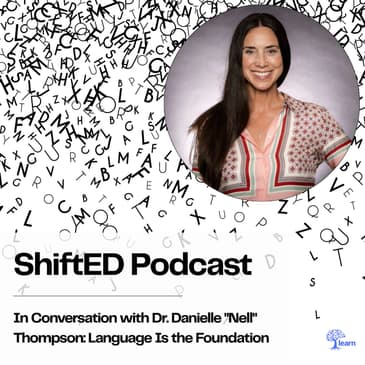
In this episode of the ShiftED Podcast, Chris Colley sits down with Dr. Danielle "Nell" Thompson — literacy leader, coach, and former speech-language pathologist — for a wide-ranging conversation on what really sits at the heart of teaching children to read.
Nell traces her thinking back to a moment standing in a museum inside the Arctic Circle, when she realized the Iñupiaq language around her had been oral for thousands of years and only written down within living memory. That single insight reshaped how she sees literacy: as a developmental extension of language itself, not a mechanical skill bolted on top.
Along the way, Chris and Nell explore why the post-2000 turn toward the "five pillars" left oral language out of the picture and what it has cost classrooms since. They dig into the difference between consulting and coaching, and why coaching changes who holds the power in a school. They talk about honouring the "Englishes" and language variants children bring with them from home, and about "we're only partially right" as a humble frame for teachers and leaders alike. Nell closes with the paradigm shift she sees coming next: full integration of speaking, listening, reading, and writing across every subject, taught by educators who understand language as the original architecture of the learning brain.
"The original architecture of the human brain that we build academic success on is the language architecture." — Dr. Danielle "Nell" Thompson
Welcome everyone. We're here at another Shifted Podcast episode. I have a a a kindred soul that that came to us in Quebec here at the first foundation's first uh symposium that we had uh completely online. So I have uh Dr. Danielle Thompson now, and she's a literacy leader coach, um speech language pathologist, and runs uh some pretty cool uh uh Big Sky Literacy Summit and the Translate of Reading Teacher Group. And we're gonna dive in big time on uh language. Her keynote I want to say, because it was it was so I love this title. Uh From Chance to Certainty, what our pharaohs reveal about the systems we built. And I was so inspired by it. I I reached out to her actually when the conference was going on. Um and well, here she is now. Thank you for coming. Oh gosh, thank you, Chris. Very pleasure to um hear you talk. And I'm glad my community brought you in um and I got to be aware of um you're a huge fan in in in my circles, and teachers really believe in your mindset. So let's spread it a bit. So my first question is language is the foundation of literacy and not a side note to it. Can you flush that out for us? And we were kind of before we hopped on here talking a little bit about that foundational, you said it way more eloquently than I. But could you unpack that a little bit? That language is the foundation of literacy, not a side note to it. Right. I I think what's I think it's important to tell a story here because I I certainly feel most days that I'm not an expert of anything. The older I get, the more I'm like, do I know anything anymore? But what I do know more than ever is the value of understanding this experience that we call language. And it goes back to my early days in rural bush, Alaska, which I think a lot of you all as Canadians uh know in northern Canada and indigenous communities. And I only worked with Indiapac, UPIC, Athabascan communities. And I just really had this remarkable revelation that uh from my exceptional training as a speech language pathologist, I had great professors really lay a foundation around the fact that um language is valuable and it will develop within an ecosystem and it it gives identity to the people. And but I don't think I truly understood that until I was in it. And I I can say at this point in my career, I was I was grateful that I had the aha moment of how massive this really was. Because it it taught me about there are the there are c there are waves of humanity that change what languages we speak through war, conquest, all these things, and what languages are valued, what cultures are valued. And and I think that we've we've started, we then were forced to acculturate to a single language, while many languages were still coexisting. And that's the part that I didn't deeply understand or value or know how to speak about. So I now fundamentally know because of this one moment in my life, it was around 2007, I would say. I was standing in a in a museum in Kotzebue, Alaska, inside the Arctic Circle. And there was this picture of a group of linguists who had come into the area to translate the Ineupak language at the time. And it was 1974-5-ish, I think. And in that moment, I was reading Louisa Motz's book, Speech to Print. And in the intro of that book, it talks about how languages had been translated from oral to written, and there were around 6,000 languages in the world, and there were all these orthographies. And then remember, I'm a speech language pathologist. So my job had been to come in and support children who had language variation and differences and disorder. And I just had this like boom moment, like lightning struck me. Like, wait a second, you mean InuPak has been an oral language completely, entirely throughout in all of history until 1975 when a linguist wrote it down. And now I'm testing children in a written language, and their brain and their people have spoken language for thousands of years. I was just like, uh, I don't it was a moment. Like I felt like I like, I knew nothing. Like I felt so humbled by that picture on the wall in the museum. And I still am humbled by it because the amount I know now compared to what I knew then, but what I did, what it was like God spoke kind of an experience that you must value who the children are, what the language they speak is, the identity that it gives them, the words that they use within their families, the way, the tone, they express their syntax, it all has value. And I can't test that on a standardized protocol. Nor can I say it's disordered or deviate. It's different than general English. It's different than the academic language we may teach, but it doesn't make it a disorder. And that was profound. And is that like is it our systems that are broken? Like are we built on the wrong foundation? I know, right? So I think you know, to tie your two. What do you do with that that realization? It's just like now what? Right, now what? Exactly. I think to to bring in that first question and the second question, so language is this foundation. So and and does yes, I believe wholeheartedly, Chris, that we took a little side journey around 2000 because whole language had brought us the idea that this language is extremely valuable. It missed a lot of components of how we teach it, how we build it, how we develop it. I'm gonna, you know, that's the evolution of science, right? But in 2000, there was a national reading panel which impacted b all of North America. And it really laid out five pillars, which is phonology, phonics, fluency, vocabulary, and reading comp, right? There's no language comp in there. There's no oral language foundation, there's no written language as the next layer of taking from reading comprehension to written expression, right? So we then had publishers organize around the five pillars. If you didn't include language in the five pillars, publishers didn't include it in the instructional materials, right? So did the system get a little bit swayed to go in one direction, is what I'm gonna say. Yeah, I think it did. I really think it did. And it's not because people didn't know oral language, we have a substantial amount of evidence prior to 2000 that that language is the foundation of reading. In fact, reading is a developmental extension of language, which is in the new reading by Snowling and Hume in 2025. It's reading is language. But what I think happened around 2000 is that we made reading into a mechanistic process because while whole language did many language contextualized experiences well, what it didn't do well is explicitly teach how oral language mapped into the printed language, which we call phonics, right? And so is it a broken system? It's not broken. It has had overemphasis into a mechanistic protocol versus an integrated oral language protocol and understanding why we take phonology and parse it into the phoneme to apply it to the printed word so we can blend it and decode it and segment it and spell it. It's taking oral language into printed language. That's the whole point of blending and segmenting and phoneme level tasks, right? And if they can and cannot do that, it predicts reading ability. That's why we screen that, right? But when you get a curriculum that only teaches phonology, as a teacher, you might have disassociated from its actual impact on the outcome of literacy and reading and how they spell and how they decode. And then phonics instruction, the layers of the language, you know, there's like 250 plus patterns in English. It's pretty amazing, right? And that's the beginning and advanced scope and sequence. But what we don't get deeply taught about is that phonics is a representation of history of oral language. So you have French into the English orthography, you have Anglo-Saxon in the English orthography, you have many Arabic, and we have Italian, and we have many languages represented in the orthography of English. But if you just teach a spelling test as a memorized task on a Friday, you miss the language of it, right? There was so much to do in that phonics lesson that had to do with language that we we began to miss by by putting things into what I would say silos. And it's profound, isn't it? So is it broken, Chris? I I think I think it's a it did a really great job. We've done a great job of allocating resources to say, you know what, the evidence is pretty solid. We we gotta do these things. But what the evidence wasn't really solid around was how do you integrate them from an oral language base? And what if your oral language isn't the spoken English of general English? What if you have a variant of one of those Englishes? And how does a teacher translanguage into the academic English? And does curriculum account for that? Not, it doesn't. That's those are profound, in-depth things that we have to study and we have to know. So we're not there yet. But we're we're on the way. Yep. Good work. We're bringing awareness to it. That that's right. And it kind of brings me to my next question, though, is that you talk about you're not a consultant, you're more of a coach, right? Yeah. Does how does coaching connect to the heart of all this? Because if things are shifting and like you have pre-service teachers that are, you know, have a mindset around what language is and how it's to be taught in schools, and like how do you get in there to start coaching to maybe change the mindsets a little bit so that it is seen more as you know, language is the foundation. Let's start there and then like how does consulting versus coaching? I I love the idea of coaching because it's that encouragement and that support. Um can you can you put a few words to that for us? You know, Chris, I think that it's this is an interesting question because I I bumped up to this vocabulary word consultant a lot because Dr. Nell is here, she's our consultant. And I was like, yikes, I I uh actually understand the word consultant means I've come, I'm coming in to solve a really big problem and I'm gonna walk away tomorrow and y'all are gonna just get it done. And reality, my heart of hearts was like, I am not solving this complex puzzle in a day. Um, what I will try to do is solve some observable variations in directionality that we can start to move towards and and then I'll coach us into our next best step. That that's it really hit me that I needed to, my I think what's so important for for myself and for all the listeners out there is that we identify with who we are by um defining what we know about our actions. Like so for me, I I identify with being a human who cares deeply about other humans and valuing what they're bringing to the experience. And if I'm the consultant, it means I am more important and I'm going to solve this problem and you are going to then follow. And that just does not resonate with me. So to be clear, pulling all this together in coaching now, one of the deepest truths that I can offer any human being is that when we change from the inside, we'll change others around us, right? So that's a pathway of influence and trust, and we build that through credibility. But one of the things around language that I'm now more deeply seeing is honoring that each one of us as adults, as teachers, as leaders, have our unique experiences and identities and the languages we speak and how we bring that into the classroom. And one of the fun coaching points I'm now getting into, Chris, and I think it's important to emphasize because I think when you're coaching, remember all people deserve to have a great coach. There's a great article by Atulga one day in the New Yorker years ago, I think it's 2011, and just about the kind of performance you get with people who get coaching, even you know, medical doctors, surgeons, and and he was a surgeon and what a coach did for him, right? And it just kind of blows me out of the water that if we can really teach that the brain that we have within our head, think about the thousands of years of human evolution, it is fine-tuned for language. That's that's what it did really well. And it wasn't until, you know, this invention of written language came along that we required reading and writing in society. And so, andor math for that reason, you know, none of that. So the the original architecture of the human brain that we build academic success on is the language architecture. And interestingly, in this world we live in now, the digital age, the maybe the change in human interaction as artificial intelligence comes in, we should start to be thinking about who are we as humans and what makes us so special. And it's our language, how we how we combine words and how we share them, and the depth of our knowledge comes from how we express language. It's it's innate to us, and the way we use it is innate to humans. And isn't that profound? So when I now that I'm in this coaching experience, and I just I just get inspired by being human and having language and and translating that into what that could look like, you know, what we're going to teach phonology. But isn't it amazing that this stream of speech can be parsed into individual sounds that get mapped into a written-coded system that was an invention and how complex that might be for some children. So there's, you know, like, yeah, coaching is a totally different world. And it is about empowering the person and yourself to just rise into your true potential. And, you know, like this year at the Big Sky Literacy Summit, I'm calling it activating genius for a reason. We all have genius within us. It's not an intellectual scaled score that you get and get to be in the genius group. That's not what we're talking about. Genius is your true core potential. Who are you meant to be? And it will be activated through how you receive and express language, right? And we'll never know it unless you express it. That's right. Well, here is a question. I love this idea of your theme of genius. What is that one thing in you that you hope to pass on or that that that you hope that we talked before about throwing seeds out and you know, hopefully they they they sprout. You can only throw them out. Um nature has to take care of the rest, which is inside you. What do you what what are those for you or that lesson that that that inside you that you want to most hand down or or hope that stays within the ether as you know, re as humans move on physically in this world? Um I know it's a huge question, but I think we're there right now at that point of like reflecting a bit on our careers and and all the experiences that we've had, and kind of, I don't know, like what is it that that you wish that that stays within the ideas of language? That is a very big question. I think what I want to say is that there is a a a deep calling within me that says that I I want to live a meaningful, purposeful life, right? I want to be able to wake up every day and know that um what I have to offer and contribute to will help others feel inspired and desire doing more for those who who exist within the ecosystem, that they teach within, they lead within, they live within. And you know, I I want people to deeply know that this process of being a human, just to speak into that idea of being genius. Um we are not computers that just get programmed with information and regurgitate information. We are we are beings that get that receive information and we internalize it, integrate it in accordance with what our experiences are and who we're interacting with. It's all a process of inputs and interaction and instruction that gets continuously, iteratively uh replicated. And I think in all of that, the more I understand that and the more I put forward into education that iterative idea of inputs, interaction, and instruction, it's gonna take a lot of failing to get this right. You know, I'm I love a book called How to Get a Return on Failure by John Maxwell. We, we, I don't know if you've been looking at the data coming out, it feels like it's all over social media, but we have a lot of awareness about the science of reading, but we don't have a lot of outcomes to prove that it's been working. So the other thing that I think what I'm willing to start talking about, and I am talking about, is that how do we we get a return on the things that we did we failed on, but that we did well? And that because great scientists, that that's who we all should want to be. We are all scientists in our classroom, we are all scientists in as leaders, we are all we're all trying to figure it out. And you're only partially right. You're never all right. Right. And that's I think that's a big thing I want to share forward is like, remember, you're only partially right. Like, you know, as a teacher out there, if you've been a teacher, I'm a teacher, not every kid gets it when you teach. And you're like, uh, you get the exit ticket and you go out the classroom if especially if you're in the upper grades and you plan this great lesson, and then you get like this exit information, like, oh gosh, 40% of them got it. Like, I thought I nailed that lesson. And the so the receptivity on the other side was not there. And so you're like, okay, so I'm only partially right. I was on I definitely did not get what they needed. Um So I really want to leave this space for all of us and know that uh language where we were, whole language, moving to the whole of language, deeply understanding that we all come to this world with this beautiful experience of language and identity and rich words within our family and communities. And it may be a variant of English, and we call those Englishes. They could be Frenches, they could be, but they're variants of the language. And so then there's these academic standards that we have. And we've been partially right about how we teach those academic outcomes because I believe that these Englishes and Frenches and whatever language is the core language of your classroom, that you are moving towards that by using the foundation of the language of the students that you're working with to master that next language. And that's, you know, that's the ultimate goal of our classroom. Because personally, I was only partially right. I used to only teach academic language. I didn't understand how to value and use the language of home and the colloquial language. And I think that's powerful and such a lesson. So always remember we're only partially right and we definitely are moving in the right direction, and that everything about our brain in academics was founded on a language brain. We built it onto, we tacked it onto the language brain. Powerful. So my final question, future looking. What do you see coming down the next big shift that might be happening? We always have these, you know, tipping points, um, which we've seen, you know, throughout language learning. What what do you see is coming in the future that you can make us aware of? That's a big question too. I think to dovetail off of being partially right, I think I'm really starting to see that our curriculums, the the published resources I should talk about, um the paradigm is shifting to this more full integration and full internalization of the oral and written language. So we have speaking, listening, reading, and writing fully integrated, not compartmentalized, not put into those five pillars. Um what does that look like, sound like, uh, and feel like in a classroom? And I remember the days of having teachers be compartmentalized, right? What am I talking about? That's still today. So, especially in the upper grades. So, where I'm going with that is I'm starting to see a future where uh if we're really gonna do it well, we would have to understand that this language brain is the original architecture. And then we build onto that these academic foundations that then lead into exponential learning about content, domain knowledge, background knowledge, all these beautiful things that happen that are teachers of science, teachers of social studies, teachers of math. We actually learn these content areas deeply. So when we teach them, we teach them from the language foundation. And it's a full integration and internalization for that student that it's not, oh, now I only do math. Well, math is richly embedded in language. And now I only, well, social studies, well, it's yeah, wow, those are a lot of rich language depth of history. Like most of the words in social studies have a lot of etymological history to them. So there's a lot of language. And I think that the future paradigm is where teaching prep programs start to value how we train teachers around language, that it's an inter has to be interdisciplinary, cross-disciplinary, and it can't be left to an idea that the ELA curriculum will solve the problem. It's a human that does this work, a human with depth of knowledge around language. It's a teacher and a leader who are leading a language revolution of full integration across the resources and the curriculum design for the students that you're teaching. That's the paradigm I hope to see. And I'm not saying I can do it right now, but I certainly know that when I sit down to think about a lesson that has a curricular resource and as a backbone, I can look at the resource and say, oh, well, it does this well. It does, it doesn't do speaking well. There's no oral language in it. It doesn't do the written language expression well, but it has these standards for maybe reading narrative text or expository, good text analysis. It's got all this idiomatic inferential. Okay, all that's there. But I need to build out the bones of a rich language lesson from this resource to enable me to bridge the gaps between where we where we are and where we want to be. Well it sounds easy, but we know this takes a long time. And thank goodness we have coaches like you out there supporting our people on the ground. And also passing on this mindset, like you talked about aha moments. I think I've had about three or four as we've talked here today. Daniel, like I really appreciate your insights into this and your stories and how you tell them make them human. Um when we kind of tend to remove a lot of that stuff in instruction and school, we rip the heart sometimes out of things and you put it back in for me anyway about language. So I really appreciate your time and your insight into this. Oh, you're very welcome. I very much appreciate being a part of this a dialogue and conversation, and maybe we'll we'll meet again and in person. Absolutely, that'd be amazing. That conference, though, and I want to say so, listeners out there, if you can check out Big Sky Literacy Summit. Yeah. It's every year, right, Danielle? Every year it's happening at the end of August, and sometimes it's at the beginning of August. It just depends, but we certainly I would love to see you there. It's in Montana. Amazing. Thanks so much. Yeah, thank you.