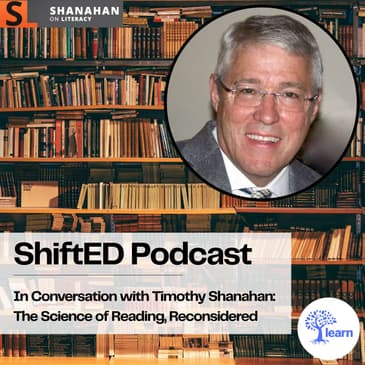
On this episode of the ShiftED Podcast, Timothy Shanahan joins the conversation to unpack the evolving debate around literacy, reading instruction, multilingual classrooms, and the “science of reading.” Drawing from decades of research and his book Leveled Reading, Leveled Lives, Shanahan explores why strong reading comprehension still sits at the center of critical thinking, digital literacy, and student success. From Québec classrooms to broader global conversations about AI and education, this episode challenges educators to move beyond buzzwords and reconnect literacy instruction to evidence, knowledge-building, identity, and belonging.
Welcome back, everyone, to another episode of Shift Ed Podcast, uh scouring the world for thinkers, researchers, educators to uh make our understanding of the world of education a little bit clearer. And have I got a surprise for you all? I have Dr. Timothy Shanahan here with me today, um, professor at University of Illinois. Uh he helped found the Center for Literacy there as well, author, researcher. Great book called Leveled Reading, Leveled Lives. And we're gonna jump right in, Tim. My first question is a really basic one. What is literacy? What is it? We have digital literacy, we have AI literacy, we have media literacy, we like what is it at its core? I guess I'm baskin.
Tim ShanahanThe term literacy has really come to mean general knowledge, and and that's why it's used in all the ways you were just describing. But most fundamentally it really refers to the ability to uh read print, to be able to translate print into language and and language into print, to be able to go both ways. If you're literate, you should be able to read and write. It's not always the case, but it should be. And so, yeah, reading and writing are and and it doesn't matter which language we're talking about, that's pretty standard. And then, you know, people will, oh, you know, here's auto literacy or here's you know AI literacy, and they just mean here's some information about that topic. Uh, I don't love that use of it, but it's literacy is such a powerful term because reading and writing are so fundamental in our intellectual lives, our civic lives, our social lives, that frankly you can't blame them for wanting to getting in on the free why I term to everything.
Chris ColleyThat's exactly right. And Tim, I mean, I do a lot of uh work with early childhood educators, preschool into grade one and two. And we always talk about the kids' kind of like early developmental stages that all kids kind of grow at their own pace, right? And we we we shouldn't like interfere in that natural process that happens as kids grow up and come into their own. Does this apply also to reading and writing? Like, are are those same ideas that we have to do it at a sp not a specific time, but we have to like let the learner come into it rather than us push it on them? Can you expand on that idea a little bit?
Tim ShanahanYeah, I mean, first of all, I mean, one of the things that linguists and psychologists and so on have certainly made clear to us is that literacy development really begins really early. It's you know, kids are getting exposed to text all kinds of ways. And, you know, uh whether parents are reading to them or uh, you know, taking them on the cart through the supermarket, you know, the kids are seeing words and wondering what that's all about. As early as 18 months, 12 months, you know, I mean, it's really it comes in very early. When I became an educator, now we're talking a long time ago. This is, you know, dark ages kind of stuff, but uh, you know, kids were supposed to learn when they were in first grade. They were supposed to learn to read. They'd start first grade year not reading, and by the end of the year they had to be reading. And it put a lot of pressure on uh, you know, that notion that everybody was going to get this at the same rate. And, you know, of course, parents were also supposed to try to delay kids from learning to read. You know, don't allow that to happen because it would hurt them, supposedly. I mean, they really thought it was going to cause mental illness and all kinds of crazy stuff. So essentially, what I came to embrace the idea of whether you're a parent or whether you're a preschool teacher or a kindergarten teacher, we should really start teaching literacy really early, not with the idea of, oh, they're going to be at much higher levels, but it essentially extends that whole ramp. Instead of it being three months or six months or a school year, gee, it's three years, four years, five years to make the same kind of gains that we used to make. And I think that's a a more respectful approach to uh those developmental issues that you're talking about. But more importantly, I think it it makes sure that every kid gets the maximum chance of success. You know, imagine that youngster who isn't quick but slow at language learning, who used to be find themselves at the end of first grade being a failure, and now it's, well, you know, I stared at this two years ago and you know, I'm doing fine. You know, it's and so it's if you think about it, if you're trying to get a car up a ramp uh and you're having trouble doing that, you have you can do two things. You can either apply more pressure or you can make the gra the lamp the ramp more gradual. And I'm really calling for making the ramp more gradual. Interesting. I like that analogy.
Chris ColleyReally? It makes uh so this idea of like preschool or kindergarten having to prepare the students for cycle one, like, oh, they need to read and they need to know how to write, and like that seems a little bit pre-emptive a little bit. Like again, you're having that extended ramp that they start young but can like go for long.
Tim ShanahanAbsolutely. So as a parent, if I'm reading to my youngster and they're two or three years old, uh encouraging the youngster to participate, not just to listen, but to take part in it. Kids love to try to read it and you know, to figure out what you're reading on the page and all that, and that's fun to involve them in. So that's one kind of piece of that. Another piece of that is I mean, go to any toy store. You're gonna find all kinds of alphabet blocks and posters and all that stuff, and nothing wrong with any of that. Bring that into the house. And and certainly don't be afraid to let your youngster play with paper and pencils and crayons and markers. Yeah, keep the the unwashable markers away from them. That's but that's not to protect them from literacy. That's that's you just don't want damage done. And and so kids will start pretending. I mean, I as a little kid can remember pretending to write. I didn't know I was pretending. I thought I was doing the same thing everybody else was doing. It just you know, there's a there's a social requirement in literacy that we both have to agree to this, and and the symbols have to be shared. Uh, but that's all stuff that little kids have to learn, and they learn that from those kinds of interactions. And so whether it's you know, mom pouring the bowl bowl of cereal and you know, pointing to the words on it and saying, hey, look, it says cornflakes. Uh that's teaching too. And so we I think it's important to start engaging kids in that really early. Uh they like it, it's good for them, and it it does uh I don't know if it prevents later problems, but things that would take longer for some kids to get, it gives them that extra time.
Chris ColleyInteresting. Interesting. Without like it being, yeah, like forcible. It's like, no, no, we have to do our four hours of reading tonight.
Tim ShanahanLike no, and I oh no, no, no, and I don't want parents doing that. It's not, oh, I'm gonna teach them, you know, a letter every week. Teach him a letter every time it's convenient. Teach him, you know, oh gee, he's interested right now. He was interested for five minutes, sending one to go play with his trucks. Let him go play with his trucks. Uh that's not gonna hurt a thing. Don't be surprised if he's back an hour later wanting to play with the letters again. You know, little kids, that's all they are.
Chris ColleyTim, I wanted to jump into a little bit of this kind of dynamic that's going on, I feel, in our in our educational systems of this kind of like wanting to go back to basics, but at the same time trying to like incorporate, you know, the latest progressive approaches to how to, you know, I I'm kind of getting at the science of reading, you know. Where do you think that debate is right now? Um, currently in our in our world.
Tim ShanahanYeah, I you know, I I I think in terms of the debate, we're in a in a position where I uh the position we've gotten into a number of other times. I've had a very long career. I think this is my third time through all this craziness. And usually by the end of it, the science tends to win out. People go, it makes more sense to do the things that appear to give kids the greatest advantage. And and that tends to mean in beginning reading, including explicit teaching of something like phonics. And so, oh boy, we're getting back to basics. And I I think what what tends to happen is that you know, there's this huge argument every time you get back to this point where it might be done politically or you know, governmentally, where you know legislatures or school boards, or somebody steps in and says, no, you got to do this. You're you're gonna have to make this happen. And and then it sometimes tends to go a little too far. It you know, people go, okay, of course we should teach phonics, or we should teach the alphabet, or we should teach, you know, or if it's m you know, math, uh, you know, you might be, oh, that you have to teach multiplication tables or whatever. And then there's this sort of, I think we're teaching too much phonics, I think we're teaching too much. And so it's like you get to the top of this and then it kind of curves. And I think that we're at that little bit of a curve or inflection point right now. That's what it looks like to me.
Chris ColleyRight, right, right. And do you find that the research that's done in this transfers into the classroom? Because you were just mentioning that that science tends to be what people rely on. Um but does the research actually do you see it transferring into the classroom where teachers are taking what researchers are saying is effective and actually applying it within within the four walls of their classrooms?
Tim ShanahanYeah, eventually. Uh you know, this is one of those deals that, like I say, there's usually an argument for a while, and then what starts to happen is districts, school districts buy new programs, they bring in professional development specialists to teach the teachers how to do certain things, and and and things do tip. Now the the issue becomes, you know, do they do they learn enough or do they have enough support to actually do what the research says, or is it just a pale imitation that makes it look like you're doing the right thing, but doesn't really work the way it did in the research? And I think you'll I I think depending on the degree of support, how wise the leadership is, I can I'm sure I could go out and find dozens of examples of both. Uh you know, here's a here's a group that has taken the research and found good ways of putting it into practice and made sure their people were on board and their achievement is going up and the kids are happy and the teachers are satisfied that this has been a good thing to do, and other places where people have appeared to do it, and yet nothing's really getting better. Um, if you take a really close look, are they really doing what uh they were supposed to? And then if you trace that back, you'll find, well, they didn't really give them any training in it. They just told them they had to do it, or you know, they bought a program, but they didn't make sure they knew how to use it, or you know, you know, all those kinds of things come into it. I mean, I've I was a director of reading for the Chicago Public Schools, and you know, we managed to bring the research into our 600 schools and our you know tens of thousands of classrooms uh successfully. But I saw things that were happening where uh, oh, you've got to buy a new program, but you don't have to use it. Don't you don't even have to open the boxes, you know. And you go, well, that's idiotic. You know, that that that's that is so foolish. Please, please don't do dumb things. We're talking about our children, our grandchildren, you know. So that both of those happen, sadly. But it it can it work? Has it worked? Are there places that have raised achievement? I can I show you historical periods when this was going on and achievement went up. I definitely can. So it it is transferable to classrooms, but it takes work to do it. It isn't just snap your fingers and teachers jump into line and do what they and I'll ex it, you know, this stuff takes a lot of learning, it takes a lot of support, it takes encouragement.
Chris ColleyRight. Yeah. Well, it's like everything, eight times in education, it's a slow-moving creature. And it's a lot of support to to shift practice, you know, it's a lot of support. Um which kind of like my I'm curious about like what's the what's been like the most interesting research that you've been involved in over your career? I know that's a huge question, but were there certain ones that were just like yes, yes. And that that you still today are like, I mean, that was just like years ahead of time.
Tim ShanahanLike w did you have any other situations? I've actually had that kind of a career. And you know, graduate students will ask me, how do you do that? And I have no idea. You know, I I can tell you a story about when I was working on my doctoral dissertation, and anyone who's ever worked on a doctorate knows that you know that once you survive the beginning part of it, every waking minute is trying to figure out what in the heck you're gonna do your dissertation on. And I during the period of time when I was working, all the research that was being done, all the major stuff, everything that was in the journals was about reading comprehension, understanding the processes of how people comprehend, are there ways of teaching comprehension effectively and so on and so forth? And so that's really where the ball was in play and everybody wanted to be part of it. And I came up with a different kind of an idea. You know, it it occurred to me that it takes a long time to do a good piece of research. You know, it's not like it's it's just like getting teachers to do something really well. It takes time for them to develop and learn. And to do a good study can take, well, you know, from design to you know, publication, might be years. And, you know, it literally. And and so you think, gee, if everybody's publishing a certain thing right now, and it takes me two years to get this project done, who's gonna care if it's about something that's hot right now? So I you better look at what's really interesting to you or what's important. And what I decided really was important or might be, uh, and I based it on my teaching career, was this whole idea of putting reading and writing instruction together. Could you integrate that instruction in some powerful way? Because schools, for the most part, weren't doing much with writing at the time, at least in the States. And and that notion of, gee, writing is important. We want that to come along too. And I, in my experience, was telling me if you had kids writing, they picked up on what we were considering the reading skills faster and more certainly. And so I thought that was really important. So I took that to my advisor, who said, well, you could do that, but you you you know, no one will be interested. And and it, you know, it was true, there weren't any studies on that, you know, of any, you know, um uh value or you know recency. So I said, okay, well then that's fine. I you know, I can live with it because I'm interested in it, I'll do it. And not knowing, I mean, just before I finished, or right around the time I finished it, and I had done the dissertation, was polishing it into a research article that could be published. Uh, somebody else published a just a think piece about how important it was to connect reading and writing. And it was one of those papers that really catches on, right? Everybody's interested, you know. Uh and oh my goodness. And nobody had any data except, well, there was one doctoral student. So all of a sudden, this was really important work, and everybody wanted to know about it. And for about two or three years, it was hard to publish anything that didn't connect right in. And I was kind of a star uh by accident. And and that's happened to me two or three times in my career, where just going, not going where the ball is now, but maybe where it should be or where you'd like it to be, is the you know, the way to think of it. So you know, that would be one example. And you know, I look at it now, I you know, I did that research for a long time and then felt like I'd done everything I could do to contribute to it, and then got away from it for a while, didn't even bother to try to monitor it. I, you know, I wasn't uh, you know, even watching, I put my focus on other things. And then somebody asked me if I would write a like a research review on the topic for a handbook, you know, go back, you know, this. And I did, and I found all these newer studies that had been done based on my work, where these people had improved on it, extended it, really made it even you know more important than I thought it was at the beginning. And that's continued. That work goes on all over the world and in many languages now, and it's you know, I somebody asked me to write a foreword to an international book, and it's like, no, gee, I kind of created this field of study. So cool. So I I would say to anybody who's planning on doing research, don't try to chase the trend. What do you think is important? What do you think is missing? What would you like your contribution to be? Don't worry about whether other people are gonna like it, worry about whether it's good. Uh and there are standards for that. So that isn't just uh, well, in my opinion, that's terrific. And I think uh, you know, people who do that will find themselves they'll find their interest spreads, becomes contagious, it spreads to other people. Uh so that's but that but that notion of reading and writing together and that connecting is really important. Yeah.
Chris ColleyWhy why do you think that was not on anybody's radar? Like it would seem a natural kind of fit. Like you gotta read to be able to start writing or write like and does one come before the other? Can you bring both in at the same time? I mean I'm super curious now.
Tim ShanahanYeah, it's an interesting set of problems. When I was a boy, uh the way that it worked is they would start teaching you reading. They wouldn't do it before first grade, but they'd start reading it, teaching you when you were six years old. And you would you would never do any writing. You would do re and this was in the United States, it's a little different in Europe and so on. So, you know, but essentially uh first, second, third, fourth, fifth, sixth, seventh, eighth grade. Well, yeah, through eighth grade you'd learn reading, and then you'd move to literature where you'd be reading literature. And then they had senior comp. In other words, they in one semester of twelfth grade, they were going to teach you to write. And so the notion was you had to be a really good reader to learn to write. And instead of thinking about, well, gee, you know, let's talk really little kids. Initially, they're trying to understand their alphabet, they're just trying to learn what those letters are and what their names are, what they look like, what sounds you might associate with them. And they should also be learning to write them. How to, you know, you know, initially printing, I guess, but you you know, how do you get them on paper? Because, of course, if you're trying to figure this out, trying to create them helps with that whole thing. And then, you know, you keep pushing that along the well, what if when you start sounding out words and trying to read words? Well, that's a terrific time to start trying to make signs and write letters to your friends and write a diary. Well, yeah, but they're gonna spell things wrong. No, they're gonna spell things by the sounds, which is just what you're trying to teach them. And so you're making them better. And then, you know, you can push that all the way to, oh, you know, now this kids are in high school, even, and you know, they're trying to learn how to read an essay, or they're trying to learn how to read a scientific paper. Uh engaging them and trying to create those through their writing is a very powerful way to help them learn to read those. And so you've Really, yeah, instead of just trying to do this all in your head, getting this I uh you said you were you've done a lot with preschool. Those kids need to keep the stuff out of their head. They need it in their hands and in their movement and all of that. And so imagine teaching reading without having the kids trying to put stuff on paper and you know make letters with clay and all the kind of stuff, you know. So I, you know, I think we we just misunderstood this notion. We treated it like, well, you learn to read to a very high level and then you can apply it. You learn bits of reading as you go, and you can learn to apply those immediately. Uh and the the second part of that question was, you know, what do you start with? And in some ways, I mean, with little kids, it can be easier to start with the writing than with the, you know, because they like to scribble as early as 18 years ago, right? They have to be involved in it. And they like to see the stuff on paper and the different colors and all of that. And that's that's good. But if you're really talking reading and writing, the fact I said it earlier, it's a social system. You and I have to agree on the code. I mean, the first time I remember trying to write, I was I wasn't going to school at all, so I probably wasn't in kindergarten yet. And I got a letter from my grandmother, and she'd write these letters to me from Florida in cursive, and my mom would read them to me. So I thought that all you did to write was, and so I wanted to write a letter back to her. So I sat down and, you know, made all those scribbles and took it to my mom, and she wasn't impressed at all because I didn't understand that it's a social system. I that was, you know, so now it's gee, why was mine different than grandma's? It it starts to open up your thinking and to those kinds of problems. That, gee, if you just tried that the reading end, you wouldn't have figured out as early. Uh and so, yeah, uh, you know, it's as soon as it starts to become this is how we do it, this is how you join the club, then you know you can do both reading and writing. And whether on a particular skill you choose to start with one and that then the other, go for it. It's not gonna hurt, not gonna hurt a thing.
Chris ColleyThat's it. That's it. I love that idea of kind of playing with with the words and with reading, and like it's imitation, it but you're starting to understand those conventions as well at the same time. But there's a code, right? There's a way that we do it a little bit.
Tim ShanahanAnd so you you get feedback on that, which then you go, oh, is that how it works? I didn't know that. And then you know you go to the other side, oh, I can apply this, and and they do. I mean, that's the thing that's so wonderful. Yeah, totally.
Chris ColleyI guess my final question here in Quebec, we we have quite multicultural classrooms, right? And you come in with well, here in Quebec we have, you know, two we have a lot of English, we have a lot of French, right? There's probably about 80% French, but we also have a lot of immigration that comes in. So there's other languages within the classroom. How do you coach teachers into um adapting to having uh you know, not just English speakers, but you know, like all kinds of different speakers in their classrooms um to you know, like get them into the same levels as all you know the kids that might be native speakers?
Tim ShanahanYeah. Well, I think the first thing you've got to make sure that all the teachers and the school people know is that language and identity go together. You know, uh that respect for the home language is absolutely essential. You know, if kids are feeling like you don't want them there or that their language is somehow a problem or uh, you know, something that's inferior, um that that's gonna just slow things down. That's a real problem. Uh you know, so uh you want, you know, if come somebody comes to school, they're Quebeccois, they speak French, uh, that should be a matter of pride for them, and that should be a matter of respect for. I'm an English speaker, though. I've taught myself, I can read French. I'm not, I would not even try to speak it with you. But I, you know, I can I can make myself understood, but you'd be embarrassed about my mistakes. So why should you be embarrassed? I don't want to uh but so that's critical. And and you know, same thing, an English speaker ought to be, you know, proud of theirs. But of course, uh things that we're proud of can become walls or barriers as well. Uh, you know, and so uh taking on an additional language, it needs to be an issue. It should have an impact on your identity. You know, yes, I'm French heritage or I'm English heritage, uh, or these days in in Quebec, I guess Chinese and Indian are the big ones, uh, you know, in terms of numbers of people anyway. Uh but I'm also, you know, I'm those things, but I'm also a border crosser. I can, you know, yes, I'm English, but I can get on with the French and connect with them, and they don't feel insulted by me, and I don't feel insulted by them, and that works and so on down the line. Um, I'm stronger for being a border crosser, my community's stronger for me being a border crosser. Um, I if it and it's all stronger if I'm able to use both my native language and my second or third language, you know, whatever it is that somebody's doing. I think there's an interesting finding that comes out of the research. Uh well, two findings. In American schools, uh study after study has found uh yeah, our biggest second language group are Spanish speakers. And so the, you know, it what do you do with Spanish when these kids come to school? And uh what the studies show is if you have a dual language program or a bilingual program where the kids get some of their initial teaching in Spanish, they do better in learning reading and learning English and so on. You know, well, that's kind of an interesting thing. But now let's look. Here's another study. Uh, the kids who do best in those things, their families at home try to speak English. You go, no, wait a minute. The school's trying to speak Spanish, and the parents are trying to speak English. And what do you think that's telling kids? And I think that's what it's telling kids is one, you're welcome here when it comes to the schools, and the parents are saying, yes, and we want you in those schools learning that other language. And that it's that acceptance going both ways. And so schools have to, I say respect for home language, that means allowing the kids to use that language at school, encouraging the parents to come to the school and visit with the teachers, whether you need translators in some cases or not. Uh, try to put those meetings on some kind of common ground so that they can be at comfort level. And so I those would be the kinds of things I would want teachers to know. Absolutely. I love that.
Chris ColleyWhat a beautiful uh note to end on, Tim. I love how you just connected the identity piece, and I think that's crucial because people need to know who they are and be respected for who they are, right? Like it's just it can be that easy. Absolutely. Well, I knew that you were gonna make us all smarter, and there you did. You just did that. Thank you, Tim. I really appreciate your words and your insightfulness into this massive topic. I mean, it's a foundation, it's a huge topic. Yeah. Well, thank you for having me, Chris.
Tim ShanahanI hope this is useful to somebody out there.
Chris ColleyWell, it was very useful to me for one, and there's one check. That's a win. Thanks so much, Sue. I really appreciate it. Thank you. Good luck to you. Nice.